Basketball Betting Terms: The Complete Glossary for UK Punters
 Available in US
Table of Contents
- What Every UK Bettor Needs From This Guide
- How Basketball Odds Work Across Three Formats
- The Big Three: Spread, Totals, and Moneyline
- Parlays, Teasers, and Accumulator Bets
- Prop Bets, Futures, and Outright Markets
- Live and In-Play Betting Terminology
- Bookmaker Slang Every Punter Should Know
- Learn the language of the odds board
- UK vs US Basketball Betting Language
- Basketball Betting Market in Numbers
- Integrity, Scandals, and Responsible Betting
- Frequently Asked Questions

Nine years of covering basketball wagering markets, and I still remember the look on a mate’s face when he placed his first NBA spread bet at a London pub. He’d backed the Celtics at -6.5, watched them win by six, and couldn’t understand why his slip was a loser. “But they won,” he kept saying. That gap between watching basketball and understanding basketball betting is exactly why this glossary exists.
Basketball betting is no longer a niche pastime for American sports fans with cable packages. The global basketball betting market sits at $8.7 billion and is projected to reach $18.4 billion by 2033, and basketball accounts for 15-18% of all global sports wagering activity. For UK punters, the NBA schedule runs from October through June — prime evening viewing, with most tip-offs landing between 11pm and 3am GMT. That timing has turned basketball into one of the fastest-growing betting sports among British punters who want action after the Premier League full-time whistle.
In some US operator datasets, basketball’s share of total betting activity climbs as high as 31% — punching well above its weight relative to the sport’s broadcast footprint in the UK.
This glossary covers more than 80 terms — from the basics that every first-time punter needs, through to sharp-bettor vocabulary that separates weekend gamblers from disciplined handicappers. I’ve structured it around how bettors actually learn: odds mechanics first, the three core markets second, then expanding into parlays, props, live betting, and the slang you’ll hear on any betting forum. Every term gets context, not just a one-line definition. Where a worked example clarifies the maths, I’ve included one. Where UK and US terminology diverge, I flag both versions.
This guide is written for UK-based punters. I default to decimal and fractional odds, reference GBP stakes, and note where UK bookmaker offerings differ from their American counterparts. If you’re used to seeing -110 or +150 and want to understand what those numbers mean in your format, you’re in the right place.

Whether you’re placing your first moneyline bet on an NBA regular-season game or evaluating closing line value on a EuroLeague spread, the language of basketball betting is the price of entry. Master these terms, and every odds board, every betting slip, and every sharp take on social media becomes legible. Skip them, and you’ll end up like my mate — staring at a losing ticket wondering what went wrong.
What Every UK Bettor Needs From This Guide
- Basketball betting runs on three core markets — spread, totals, and moneyline — and every other bet type (parlays, props, futures) builds on them
- The global basketball betting market is valued at $8.7 billion and projected to reach $18.4 billion by 2033, with over 70% of volume flowing through mobile platforms
- UK punters must navigate three odds formats (fractional, decimal, American) to compare prices effectively across bookmakers and consume US-produced analysis
- Live betting now exceeds 53% of all online betting activity, and micro-betting on individual possessions is the fastest-growing segment
- Recent integrity scandals — 34 arrests in a 2025 NBA fraud case and 29 manipulated NCAA games — make responsible gambling practices and UKGC-licensed platforms non-negotiable
How Basketball Odds Work Across Three Formats
The first time I tried to compare NBA lines across a UK high-street bookmaker, a European exchange, and an American sportsbook, I had three different numbers staring back at me for the same event. Same game, same market, same implied probability — three completely different representations. That confusion costs real money if you don’t resolve it early.
Every basketball betting market expresses probability through odds, and the format changes depending on where the bookmaker operates. UK bookmakers default to fractional odds, European platforms and exchanges lean on decimal odds, and American sportsbooks use moneyline-style plus/minus notation. All three describe the same underlying relationship between your stake and your potential return. The difference is cosmetic — but if you can’t read all three, you’ll struggle to compare prices across platforms, which is one of the most basic edges available to any punter.
Fractional Odds
Fractional odds are the traditional UK format. A price of 5/2 means that for every GBP 2 you stake, you win GBP 5 in profit, plus your original stake back. The number on the left is your profit; the number on the right is your stake. When the left number is larger (5/2, 3/1), the selection is odds-against. When the right number is larger (1/3, 2/7), it’s odds-on — you risk more than you’ll profit. For basketball spreads, 10/11 on either side is the standard price, telling you the bookmaker is charging roughly equal juice on both outcomes.
Decimal Odds
Decimal odds dominate European exchanges and are increasingly the default on UK platforms for international sports. A decimal price of 3.50 means your total return per GBP 1 staked is GBP 3.50 — that includes your original stake, so profit is GBP 2.50. The beauty of decimal for basketball is speed: multiply stake by price, and you’ve got your total payout. No mental arithmetic splitting numerators and denominators. The UK gambling industry generated GBP 16.8 billion in gross gambling yield in the year to March 2025, with the online segment contributing GBP 7.8 billion — and that online segment overwhelmingly presents odds in decimal format.
American Odds
American odds use a plus/minus system anchored to $100. A price of -110 means you must stake $110 to win $100 profit. A price of +150 means a $100 stake returns $150 profit. Negative numbers indicate favourites; positive numbers indicate underdogs. You’ll encounter American odds whenever you read NBA analysis from US-based sources, and some UK platforms let you toggle to this format. The critical thing to internalise: -110 on both sides of a spread is the standard American vig, equivalent to roughly 1.91 decimal or 10/11 fractional.
Converting Between All Three Formats
Suppose you see an NBA spread priced at -110 (American). To convert to decimal: divide 110 by 110, add 1 = 1.909. To convert that decimal to fractional: 1.909 – 1 = 0.909, which simplifies to approximately 10/11.
Going the other direction — 5/2 fractional to decimal: divide 5 by 2, add 1 = 3.50. Decimal to American: 3.50 – 1 = 2.50, multiply by 100 = +250.
For odds-on prices: 1/3 fractional = 1.333 decimal. Decimal to American for sub-2.00 prices: 100 divided by (1.333 – 1) = -300.
| Scenario | Fractional | Decimal | American | Implied Probability |
|---|---|---|---|---|
| Heavy favourite (spread) | 10/11 | 1.91 | -110 | 52.4% |
| Slight underdog | 6/5 | 2.20 | +120 | 45.5% |
| Big underdog (moneyline) | 5/1 | 6.00 | +500 | 16.7% |
| Odds-on favourite | 1/3 | 1.33 | -300 | 75.0% |
| Even money | 1/1 (evens) | 2.00 | +100 | 50.0% |
Implied probability is the percentage chance the odds reflect. The formula from decimal odds: divide 1 by the decimal price. At 1.91, that’s 1/1.91 = 52.4%. Add up the implied probabilities for all outcomes in a market and you’ll get a number above 100% — that excess is the overround, the bookmaker’s margin. For a deeper breakdown of how each format works and how to find the best value across fractional, decimal, and American odds, I’ve written a separate guide that walks through every conversion step with NBA-specific examples.
Once you can read the odds in any format, the next step is understanding the three markets where those odds appear most often — and where the vast majority of basketball betting volume flows.
The Big Three: Spread, Totals, and Moneyline
A colleague once told me that if you understand three markets, you understand 90% of basketball betting. He wasn’t exaggerating. The point spread, the totals line, and the moneyline form the foundation of every NBA, EuroLeague, and college basketball betting card. Everything else — parlays, props, live bets — is built on top of these three.
The Big Three at a Glance
Point Spread: bet on the margin of victory. Totals (Over/Under): bet on the combined score. Moneyline: bet on who wins, no margin required. These three markets account for the overwhelming majority of basketball betting handle worldwide, with the NBA alone generating roughly 60% of all basketball betting revenue globally.
Point Spread (Spread, Line, Handicap) — a number set by the bookmaker that the favourite must win by for a bet on them to pay out. If a team is listed at -6.5, they need to win by 7 or more. The underdog at +6.5 covers the spread if they lose by 6 or fewer — or win outright. Half-points eliminate the possibility of a push (a tied result against the spread). The standard price on either side of a basketball spread is 1.91 decimal (10/11 fractional, -110 American).
Spread Calculation: GBP 20 on a -5.5 Favourite at 1.91
Your team wins by 8. The spread is covered.
Total return: GBP 20 x 1.91 = GBP 38.20
Profit: GBP 38.20 – GBP 20.00 = GBP 18.20
If your team wins by only 4, the spread is not covered. You lose your GBP 20 stake.
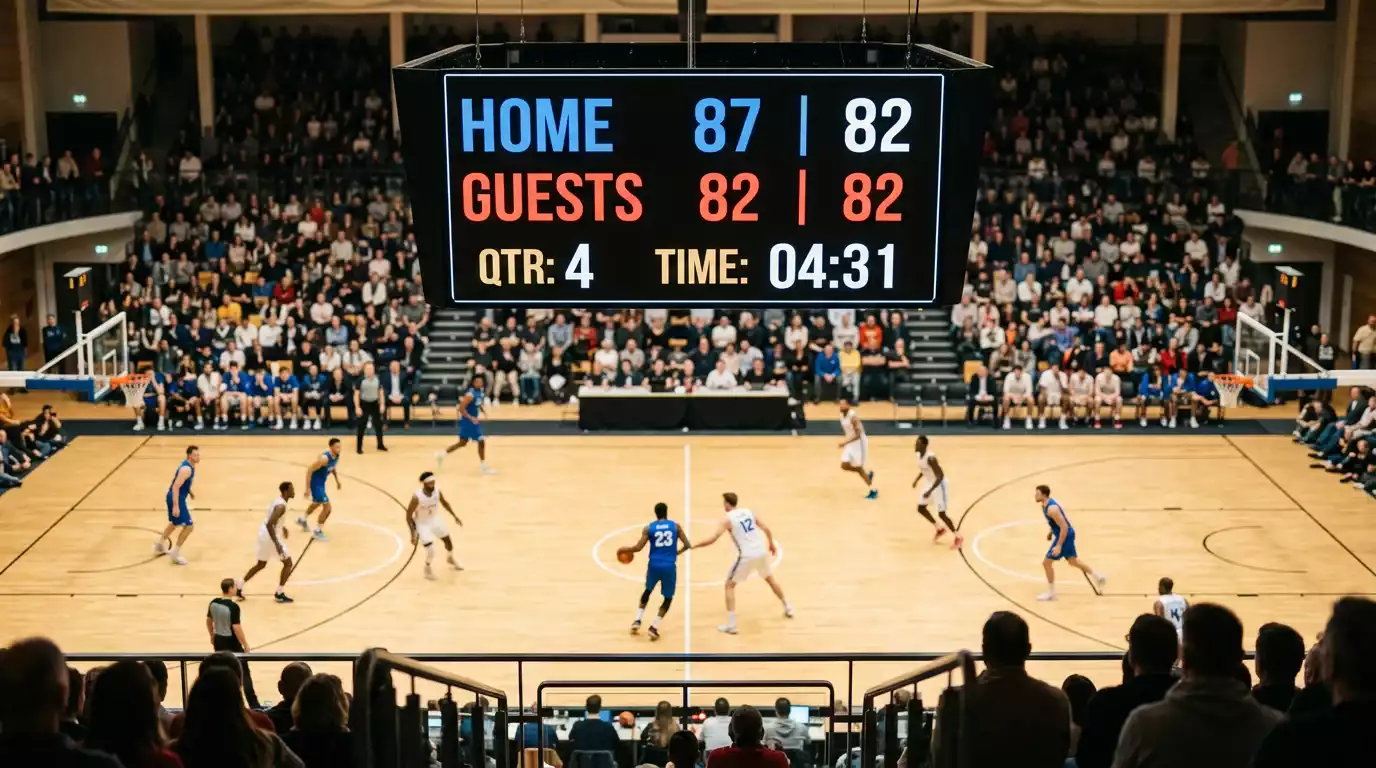
Spread betting is the heartbeat of basketball wagering. The number reflects the bookmaker’s assessment of the gap between two teams, and it moves based on where the money flows. I’ve seen NBA spreads shift by three full points between the opening line and tip-off — that kind of movement tells you that sharp bettors have identified value the market initially mispriced. For a detailed walkthrough of ATS records, key numbers, and spread-specific strategy, see the full basketball point spread guide.
Totals (Over/Under, O/U) — a single number representing the bookmaker’s expected combined score of both teams. You bet whether the actual total will be over or under that line. An NBA game might be set at 224.5 — if the final score is 118-110 (228 total), the over wins. If it’s 105-112 (217 total), the under wins. Half-points again prevent pushes. Totals are heavily influenced by pace, defensive efficiency, and rest days.
Live betting dominates the modern sports wagering landscape, and totals are where that live action concentrates in basketball. The pace of an NBA game fluctuates wildly between quarters — a first half played at 102 possessions per 48 minutes might slow to 96 in the second half if a team goes to its half-court offence. That shift rewrites the totals equation in real time.
Moneyline (ML, Win Bet, Straight-Up) — the simplest market. Pick who wins the game, no spread involved. The catch: favourites offer low returns and underdogs offer high returns, reflecting the perceived probability gap. A heavy favourite might be priced at 1.15 decimal (2/13 fractional), meaning a GBP 10 bet returns just GBP 11.50. An underdog at 6.00 decimal (5/1) returns GBP 60 from the same stake. Moneylines are cleanest when the expected margin is narrow — both sides offer reasonable value, and you’re simply picking a winner.
The relationship between spread and moneyline is direct: the larger the spread, the wider the moneyline gap. A 2-point spread might have moneyline prices of 1.55 and 2.60. A 12-point spread could see the favourite at 1.04 and the underdog at 12.00. Understanding when to bet the spread versus the moneyline — particularly with underdogs — is one of the first strategic decisions a basketball bettor faces.
Parlays, Teasers, and Accumulator Bets
I’ll be honest: the first parlay I ever won was a four-leg NBA accumulator on a random Tuesday night, and the payout was intoxicating. It was also the worst thing that could have happened to me as a developing bettor, because I spent the next three months chasing that same high with increasingly reckless accas. Parlays are the most exciting and the most dangerous bet type in basketball — and every punter needs to understand the maths before the adrenaline takes over.
Parlay (Accumulator, Acca, Multi-Bet) — a single bet that combines two or more selections. All legs must win for the bet to pay out. The odds multiply together, creating larger potential returns from a smaller stake. In the UK, this is almost always called an accumulator or acca; in the US, it’s a parlay. The mechanics are identical.
Three-Leg Accumulator Payout
Leg 1: Team A moneyline at 1.80 decimal
Leg 2: Team B spread -4.5 at 1.91 decimal
Leg 3: Game C over 221.5 at 1.87 decimal
Combined decimal odds: 1.80 x 1.91 x 1.87 = 6.43
GBP 10 stake: total return = GBP 64.30, profit = GBP 54.30
If any single leg loses, the entire bet loses. That’s the trade-off.
Teaser — a special type of parlay where the bookmaker lets you adjust the point spread or totals line in your favour by a set number of points (typically 4, 4.5, or 5 in basketball). The trade-off: reduced odds. A two-team 4-point basketball teaser might move a -7.5 spread to -3.5 and a +2.5 to +6.5 — much easier to cover, but the payout drops significantly. Teasers are popular in basketball because the scoring increments (two-pointers, three-pointers, free throws) make specific margins less predictable than in sports like American football.
Same Game Parlay (SGP, Bet Builder, Single-Game Multi) — a parlay where all legs come from the same match. You might combine a team to win, a player to score over 25.5 points, and the total to go over 220.5 — all in one game. UK bookmakers call this a bet builder. The pricing on SGPs is notoriously opaque because legs within the same game are often correlated: if a game goes over the total, the star player is more likely to hit his points prop too. Bookmakers adjust for this correlation, which is why SGP odds are lower than you’d get multiplying the individual legs together. For the full mechanics, correlation risks, and how UK bet builders differ from American SGPs, I’ve put together a dedicated basketball parlay betting guide.
Do
- Calculate the combined implied probability before placing any accumulator — if you need five outcomes at 55% each to all hit, the true probability is roughly 5%
- Use accumulators for entertainment at small stakes, with full awareness that the expected value is negative
- Compare accumulator prices across bookmakers — the multiplied edge on each leg compounds against you
Don’t
- Chase losses by increasing your acca size — more legs means exponentially lower probability of hitting
- Assume a “sure thing” parlay exists — even three -300 favourites combined drop to roughly 70% probability
- Treat SGP/bet builder payouts as fair odds — correlation adjustments mean the bookmaker’s edge is higher than on standard multiples
Bookmakers promote accumulators relentlessly because the margin compounds with every leg. A single-bet margin of 4-5% becomes 15-20% on a four-leg acca. That’s not a conspiracy — it’s just multiplication. Parlays have their place, particularly for casual punters who want high-excitement, low-stake entertainment. But treating them as a primary strategy is a reliable path to an empty bankroll.
Prop Bets, Futures, and Outright Markets
When the NBA partnered with FanDuel in 2024 to feed real-time player-tracking data directly into sportsbook platforms, it changed prop betting overnight. Suddenly, bookmakers could offer markets on “next player to score” and “total points in the next two minutes” — micro-level propositions that didn’t exist five years ago. That shift hasn’t just expanded the menu; it’s moved prop bets from a sideshow to a centrepiece of basketball wagering.
Prop Bet (Proposition Bet, Specials) — any bet on a specific occurrence within a game that doesn’t directly relate to the final outcome. Player props set lines on individual statistical outputs: points scored, rebounds, assists, three-pointers made, or combinations like “points + rebounds + assists.” Game props cover events like first team to score, winning margin bands, or whether overtime will occur. Team props might include quarter-by-quarter results or total team three-pointers.
Player props are where analytical bettors find the most inefficiency. A player’s usage rate, minutes projection, and opponent defensive rating all feed into whether a “25.5 points” line is too high or too low — and bookmakers don’t always price these as sharply as spread or totals markets. The integrity dimension is serious, though. NBA Commissioner Adam Silver has publicly stated his wish for federal legislation rather than the current state-by-state patchwork, and has asked betting partners to pull back on certain prop bet offerings. The concern: individual player props are the easiest markets for a single participant to manipulate. For a full breakdown of player, game, and team props with research strategies using usage rate and pace, see the NBA prop bets guide.
Futures (Outrights, Ante-Post) — bets on outcomes that won’t be decided for weeks or months. NBA championship winner, conference champions, MVP award, season win totals, and whether a team will make the playoffs. In the UK, these are sometimes called outright or ante-post markets. Futures odds are longest at the start of the season and shorten as the sample of games grows and uncertainty decreases. The value calculation is straightforward: if you believe a team’s true championship probability is 12% and the bookmaker offers 10/1 (implied probability 9.1%), there’s positive expected value in the bet.
Same game parlays (SGPs) often combine prop bet legs with spread or totals legs from the same match. This is where correlation risk bites hardest: a player scoring over his points line and the game going over the total aren’t independent events. Bookmakers price SGPs to account for this, which is why the combined odds are always lower than a naive multiplication of the individual legs would suggest.
The NBA-FanDuel real-time tracking partnership means that during a live game, odds on player props can refresh based on actual court movement data — a player’s shot attempts, positioning, and minutes played feed directly into the pricing algorithm.
Futures and props occupy opposite ends of the time spectrum — futures require patience measured in months, while props resolve within a single game. The connecting thread is that both reward research depth. A punter who understands rotation patterns, rest schedules, and coaching tendencies will find softer lines in both markets than someone simply reacting to the name on the jersey.
Live and In-Play Betting Terminology
I watched a friend turn a GBP 5 pre-match loss into a GBP 40 profit during a single NBA fourth quarter, all through live betting. The game flipped momentum three times in the final six minutes, and each swing created a new price that hadn’t existed at tip-off. That experience crystallised something for me: live betting isn’t just a feature — it’s a fundamentally different discipline from pre-match wagering.
Live Betting (In-Play, In-Running) — placing bets after a game has started, with odds that update continuously based on the score, time remaining, and game flow. Live markets include adjusted spreads, adjusted totals, quarter and half lines, next team to score, and (increasingly) micro-bets on individual possessions. In-play wagering reached 53.4% of all online betting activity in 2026, and for basketball specifically, the share is even higher because the sport’s constant scoring creates a stream of natural pricing triggers.
Cash Out (Early Settlement) — a feature that lets you close your bet before the event finishes, locking in a profit or cutting a loss based on the current live odds. If you backed a team at 3.00 pre-match and they’re now leading by 15 with six minutes left, the bookmaker might offer you a cash-out value close to your full potential payout — minus a margin. Partial cash out lets you settle a portion of the bet and let the rest ride.
Micro-Betting (Next Play Betting, Rapid-Fire Markets) — ultra-short-term bets on the next play, next basket, or next possession outcome. Odds refresh every 200-500 milliseconds based on real-time player-tracking data. This is the fastest-growing segment of basketball betting, driven by partnerships between leagues and data providers that pipe court-level information directly to sportsbooks. Mobile platforms handle over 70% of all basketball betting volume, and micro-betting is designed specifically for the mobile experience — quick taps, instant resolution, next bet.
Micro-betting’s speed is by design: the rapid feedback loop creates a cycle of bet-resolve-bet that compresses the full emotional arc of a traditional wager into seconds. For punters with any tendency toward impulsive gambling, this format carries elevated risk. The responsible approach is to set strict session limits before opening any live betting market.
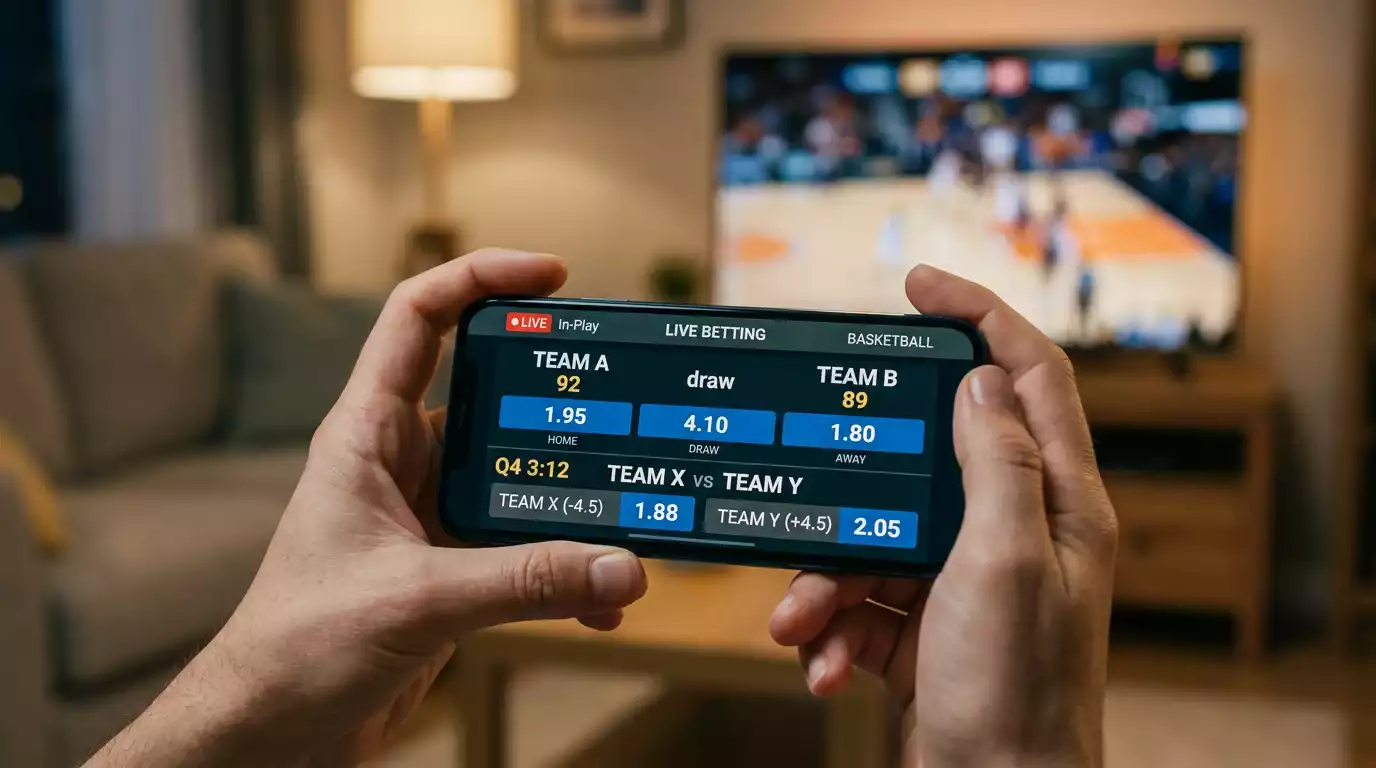
Live basketball markets extend well beyond simple adjusted lines. Quarter betting lets you wager on individual period outcomes — first quarter spread, third quarter over/under, fourth quarter moneyline. “Race to” markets ask which team will reach a specific point threshold first (race to 20 points, race to 50). Alternative lines offer spreads and totals at different numbers from the primary market, each with adjusted odds. The vocabulary of live betting is expanding as fast as the technology that powers it, and I’ve covered the full landscape — including momentum-based strategy, foul trouble analysis, and UK platform availability — in the live basketball betting guide.
For UK punters, the time-zone challenge with live NBA betting is real. Most games tip off between 11pm and 3am GMT, which means live betting sessions run deep into the early morning. That’s worth factoring into any responsible gambling plan — fatigue and late-night decision-making are a poor combination.
Bookmaker Slang Every Punter Should Know
Walk into any betting discussion — online forum, pub conversation, social media thread — and within thirty seconds you’ll hear words that don’t appear in any official glossary. The slang of sports betting is its own dialect, developed by decades of punters, bookmakers, and sharp operators who needed shorthand for concepts they discussed daily. Here’s the vocabulary that separates insiders from tourists.
Eight Terms You’ll Hear Everywhere
Juice/vig, chalk, hook, bad beat, handle, mush, steam, and the sharp/square divide. These terms appear in almost every basketball betting conversation, from Twitter threads to professional handicapper analysis. Knowing them isn’t optional if you want to follow the discourse.
Juice (Vigorish, Vig) — the bookmaker’s commission built into the odds. On a standard basketball spread priced at 1.91 decimal on both sides, the combined implied probability is 104.8% — that 4.8% excess is the juice. It’s how bookmakers guarantee profit regardless of the outcome. “Getting the best juice” means finding lines with the lowest overround, which directly improves your long-term expected value.
Chalk — the favourite. “Laying the chalk” means betting on the favoured team. “Heavy chalk” indicates a large favourite, typically a spread of 8 points or more. The term originates from the days when bookmakers literally wrote odds in chalk on blackboards, and the favourites were written most prominently.
Hook — a half-point on the spread or total. Getting “the hook” means having a half-point in your favour. If the spread is -3.5, that 0.5 is the hook, and it eliminates any push scenario. “Losing by the hook” means losing a bet by that half-point — the spread was -6.5, your team won by 6, and you lost by a hook.
Bad Beat — a bet that loses in an improbable or particularly painful way. The classic basketball bad beat: you’re covering a spread comfortably with 30 seconds left, and the opposing team hits a meaningless three-pointer in garbage time to push the margin past your number. Bad beats are emotionally devastating and statistically inevitable — every serious bettor accumulates them. How you respond defines your longevity in the market.
Handle — the total amount of money wagered on a given market, game, or over a time period. “The NBA Finals handle exceeded $500 million” means that was the collective amount staked. Handle is distinct from revenue, which is what the bookmaker keeps after paying out winners. Americans legally wagered $166.94 billion on sports in 2025, with bookmaker revenue reaching $16.96 billion — the gap between those numbers is the sum of all winning payouts.
Mush (Cooler) — a person believed to bring bad luck. If someone claims you’re a mush, they think your involvement — your picks, your presence, even your enthusiasm for a particular bet — curses the outcome. It’s superstition, not analysis, but the term persists in betting culture because variance creates patterns the human brain is wired to see as meaningful.
Steam (Steam Move) — a sudden, sharp line movement caused by heavy action from respected bettors or syndicates. When a basketball spread moves from -4 to -5.5 within minutes, that’s steam. It indicates that sharp money — large wagers from bettors the bookmaker respects — has landed on one side. Tracking steam moves is a core tool for bettors who follow line movement.
Sharp vs Square — the fundamental divide in betting. Sharps are professional or highly skilled bettors who move lines through the size and consistency of their wagers. Squares are recreational bettors — the public. Bookmakers price their lines to attract balanced action, but they pay close attention to which side the sharps favour. When public money flows one direction and the line moves the other way, you’re watching the bookmaker respond to sharp action, not public sentiment.
These terms aren’t decorative. They’re functional shorthand for real-time market analysis. When someone writes “heavy chalk, already steaming from -3 to -4.5, juice is 1.87 on the dog” — that’s a compressed market report: the favourite is large and growing, sharp money is driving it, and the underdog is now available at reduced margin. If those words make sense to you, you’re reading the market.
Learn the language of the odds board
UK vs US Basketball Betting Language
The first time an American handicapper told me he’d “hit a two-team six-point teaser on the dogs,” I needed a full minute to translate. He’d placed a teaser accumulator on two underdogs, adjusting each spread by six points in his favour. Same concept, entirely different vocabulary. This linguistic gap trips up UK punters constantly — especially now that NBA betting content is overwhelmingly produced by American writers for American audiences.
| UK Term | US Term | Meaning |
|---|---|---|
| Accumulator (acca) | Parlay | Multi-leg bet requiring all selections to win |
| Punter | Bettor (gambler) | Person placing bets |
| Bookmaker (bookie) | Sportsbook | Company offering betting markets |
| Odds-on | Negative odds (favourite) | Price where the stake exceeds potential profit |
| Odds-against | Positive odds (underdog) | Price where potential profit exceeds the stake |
| Nap | Best bet (lock) | Tipster’s strongest selection of the day |
| Bet builder | Same game parlay (SGP) | Multi-leg bet within a single match |
| Each-way | No direct equivalent | Two bets: one to win, one to place (rare in basketball) |
| Coupon / slip | Ticket | The betting receipt or selection list |
| Fractional odds (5/2) | American odds (+250) | Different formats expressing the same probability |
| Ante-post | Futures | Bets on events weeks or months away |
| In-play | Live betting | Betting during the game |
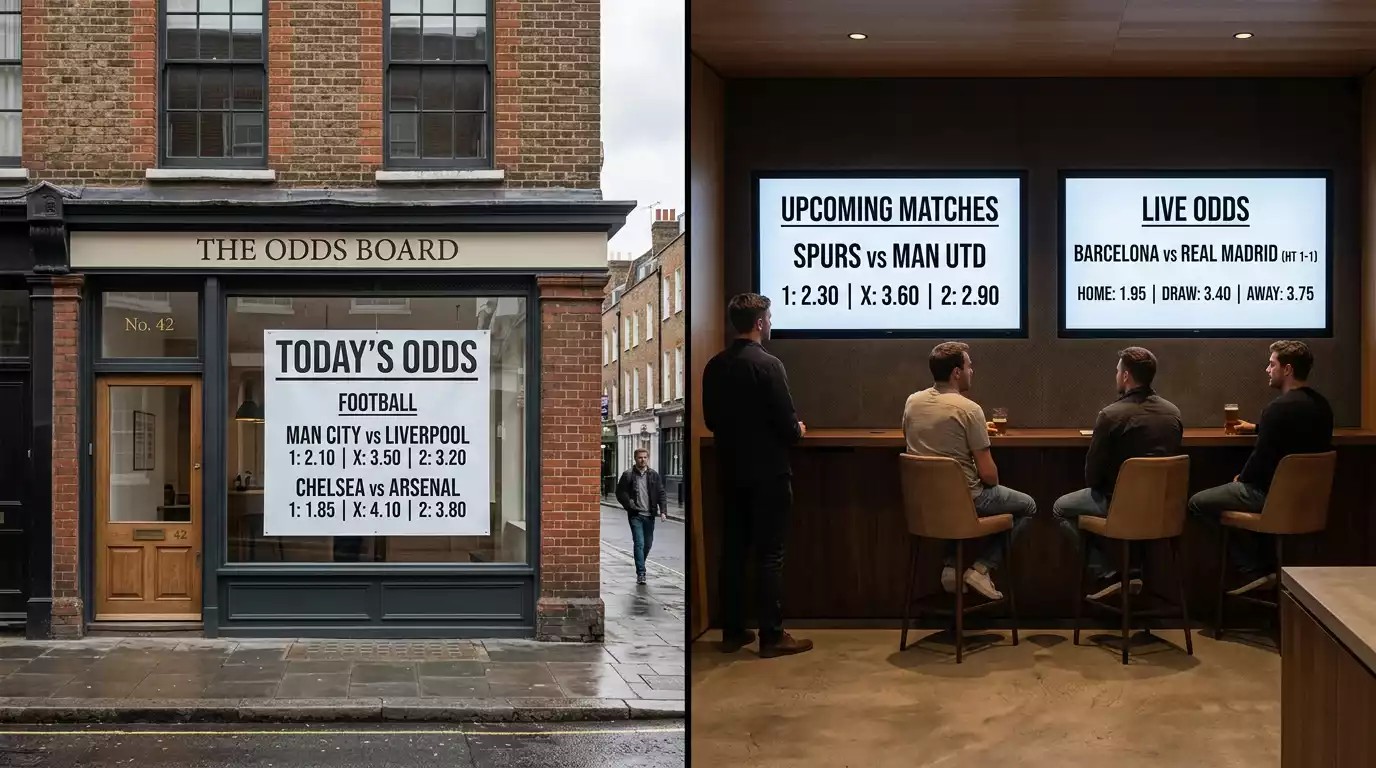
The differences extend beyond vocabulary into default assumptions. When a US source quotes -110, that’s the standard vig on a spread bet — a UK punter needs to mentally convert to 1.91 decimal or 10/11 fractional. When a UK tipster says “the acca landed,” an American reader thinks “the parlay hit.” Neither is wrong; they’re describing identical events in regional dialects.
The UK market is shaped by the UK Gambling Commission (UKGC), which regulates all licensed operators offering basketball markets to British customers. US regulation is fragmented across individual states, each with different rules about what markets are permissible, what operators are licensed, and what tax rates apply. This regulatory divergence affects everything from available market types to how prop bets are offered.
One UK-specific concept worth highlighting: financial spread betting. In the UK, firms offer basketball spread markets structured as financial instruments rather than fixed-odds bets. You “buy” or “sell” a team’s total points at a spread, and your profit or loss scales with how far the actual result lands from the number. It’s tax-free in the UK (as a financial product) but carries unlimited downside risk without a stop-loss. This has no equivalent in the US market, and it’s a distinctly British way to engage with basketball betting. Understanding both the US and UK vocabulary is essential for any serious UK punter consuming content from both sides of the Atlantic.
Basketball Betting Market in Numbers
Numbers are the currency of credibility in this industry, and the basketball betting market has numbers that would surprise most casual punters. This isn’t a niche corner of the gambling world — it’s a multi-billion-dollar global industry growing at a rate that outpaces most traditional entertainment sectors.
The global basketball betting market was valued at $8.7 billion in 2024, with projections reaching $18.4 billion by 2033 — a compound annual growth rate of 8.7%. That trajectory makes basketball one of the fastest-expanding betting verticals in the world.
The NBA drives the engine. Roughly 60% of all basketball betting revenue worldwide flows through NBA markets — regular season, playoffs, and Finals. The next tier includes EuroLeague, college basketball (particularly March Madness), and domestic leagues like the BBL in Britain. Global basketball betting gross win reached $7.9 billion in 2024 and is projected to hit $10.1 billion by 2026. North America holds approximately 55% of the basketball betting market by volume, but Asia-Pacific is the fastest-growing region, driven by mobile platform adoption and expanding legal frameworks.

Mobile devices account for over 70% of basketball betting volume globally. In the US, that figure climbs above 80%. Basketball’s scoring pace — a new event every 24 seconds on the shot clock — makes it naturally suited to mobile micro-interactions.
The demographic profile of basketball bettors skews young and male. Men comprise roughly 69% of the global betting population, and the 25-34 age bracket represents 34% of American bettors, with the 35-44 group adding another 31%. The 18-24 cohort is the fastest-growing segment, expanding at nearly 12% annually. That youth concentration matters because it shapes product development: bookmakers are building mobile-first interfaces with social features, quick-bet options, and micro-market menus aimed directly at younger users.
NBA Commissioner Adam Silver has been blunt about the stakes. After a 2025 federal investigation that rocked the league, he described the experience as deeply troubling, emphasising that competition integrity is the most important thing for the league and its fans. That tension — between a multi-billion-dollar betting ecosystem and the sporting product it depends on — defines the current moment. The money is enormous. The scrutiny is intensifying. And for UK punters watching from across the Atlantic, the market’s scale means more products, more markets, and more competition among bookmakers — which ultimately translates to better odds and broader coverage.
The UK contributes to this picture through its own massive gambling ecosystem. UK online betting generated GBP 7.8 billion in gross gambling yield in the year to March 2025, with roughly 8% of the adult population participating in online sports betting within any given four-week period. Basketball’s slice of that pie is smaller than football’s, but it’s growing — particularly among 18-34 year olds who follow the NBA through social media and streaming platforms.
Integrity, Scandals, and Responsible Betting
In October 2025, 34 people were arrested in connection with two schemes — a rigged poker operation linked to organised crime and a separate NBA betting fraud that shook the league to its core. That wasn’t an isolated incident. Federal prosecutors established that 29 NCAA games across 17 colleges had been manipulated over the 2023-2025 seasons, involving 39 players who deliberately influenced outcomes for the benefit of gambling syndicates. These aren’t historical footnotes. This is the landscape basketball bettors are operating in right now.
Ted Cruz, chairing the Senate Commerce Committee, described these scandals as a threat to the integrity of sports — and that framing captures the regulatory mood on both sides of the Atlantic. The concern isn’t theoretical: when individual player prop bets can be influenced by a single willing participant, the incentive structure for corruption is inherently different from traditional match-fixing. A player doesn’t need to lose the game — he just needs to score two fewer points, or grab one fewer rebound, to swing a prop market.
Responsible gambling isn’t an afterthought in this glossary — it’s fundamental to every term in it. Approximately 450 million people worldwide experience some form of gambling-related harm, with around 80 million meeting clinical criteria for a gambling disorder. If you’re using this guide, you’re engaging with a product that carries real risk. Setting deposit limits, using self-exclusion tools, and treating your betting bankroll as entertainment spend — not investment capital — are baseline practices, not optional extras.
The UK Gambling Commission has responded to the evolving risk landscape with significant enforcement action. In the 2024/2025 period, the UKGC carried out 9,700 compliance actions — more than double the 4,200 recorded the previous year. Britain also introduced a statutory levy of GBP 100 million in 2025, specifically to fund harm reduction programmes and research into gambling-related damage. These measures reflect a regulatory philosophy that NBA Commissioner Adam Silver has echoed from the US perspective: the belief that a growing gambling sector must be compatible with creating a safer and fairer one.
The UKGC is the primary regulator for all basketball betting activity involving UK punters. Any bookmaker offering NBA, EuroLeague, or BBL markets to British customers must hold a UKGC licence. Between 2025 and 2026, the Commission issued 741 notices to shut down unlicensed gambling sites and referred approximately 398,000 URLs to search engines for removal. If you’re using a platform that isn’t UKGC-licensed, you have no regulatory protection.
For punters, the practical takeaway is threefold. First, the markets you’re betting on are not immune to manipulation, particularly in lower-profile games and player prop markets. Second, use only UKGC-licensed platforms — that licence gives you access to dispute resolution, deposit protection, and self-exclusion tools like GamStop. Third, treat this glossary as a toolkit for informed betting, not a roadmap to guaranteed returns. The house edge exists on every market. The question is whether you’re managing your exposure intelligently.
Frequently Asked Questions
What is a point spread in basketball betting?
A point spread is a number set by the bookmaker representing the expected margin of victory. The favourite is listed with a negative number (e.g., -6.5), meaning they must win by more than that margin. The underdog at +6.5 covers the spread if they lose by 6 or fewer — or win outright. Half-points eliminate pushes. The standard price on either side is 1.91 decimal (10/11 fractional, -110 American), and spreads move based on betting action and new information like injury reports.
How do moneyline odds work for NBA games?
A moneyline bet is the simplest basketball wager: pick which team wins, no spread involved. Favourites have lower decimal odds (e.g., 1.40), meaning smaller profit relative to stake. Underdogs have higher decimal odds (e.g., 3.20), offering larger returns. In fractional terms, 1.40 is roughly 2/5 and 3.20 is approximately 11/5. Moneylines offer the best value when the expected margin between teams is narrow.
What does over/under (totals) mean in basketball?
The over/under is a single number representing the expected combined score of both teams. You bet whether the actual total will be over or under that line. For a game set at 224.5, an over bet wins at 225+ combined; an under bet wins at 224 or lower. The half-point prevents pushes. Totals are influenced by team pace, defensive ratings, rest days, and key player availability.
What is the difference between fractional, decimal, and American odds?
All three formats express the same probability differently. Fractional odds (5/2) show profit relative to stake: GBP 2 staked returns GBP 5 profit. Decimal odds (3.50) show total return per unit including your stake. American odds use plus/minus anchored to 100: +250 means 100 staked returns 250 profit; -150 means you stake 150 to win 100. UK bookmakers default to fractional, European platforms use decimal, US sportsbooks use American.
What is a parlay (accumulator) in basketball betting?
A parlay — called an accumulator or acca in the UK — combines multiple selections into one bet. All legs must win for it to pay out. The decimal odds multiply together, so a three-leg acca at 1.80, 1.91, and 1.87 pays 6.43 times your stake. The trade-off: if any single leg loses, the entire bet loses. Bookmakers favour accumulators because their margin compounds with each added leg.
What does “covering the spread” mean?
Covering the spread means the team you backed has beaten the bookmaker’s point spread. A favourite at -7.5 covers by winning by 8+. An underdog at +7.5 covers by losing by 7 or fewer — or winning outright. “ATS” (against the spread) tracks a team’s covering record: a team at 30-20 ATS has covered in 30 of 50 games, regardless of outright wins and losses.
How does live (in-play) basketball betting work?
Live betting lets you place wagers after tip-off, with odds updating continuously based on score, time remaining, and game flow. Markets include adjusted spreads and totals, quarter lines, next team to score, and micro-bets on individual possessions. In-play wagering now accounts for over half of all online betting activity. The key difference from pre-match is real-time information flow — injuries, foul trouble, and scoring runs create pricing opportunities that didn’t exist before the game started. Cash out features let you settle early to lock in profits or limit losses.
Created by the ”Basketball Betting Terms” editorial team.